
The government is developing ports across the country as centres for green hydrogen production and export, Sarbananda Sonowal, minister of ports, shipping and waterways (MoPSW) said on Tuesday. "Across the country, over 12 million tonnes of green hydrogen-based e-fuel capacity has been announced.

'At COP30, the emphasis will be on unlocking climate finance, reinforcing the principle of common but differentiated responsibilities, and building resilience through inclusive transitions and the mainstreaming of adaptation.'

That does not change with the much-expected new US announcement, it only reiterates the imbalance.

Cooking oil is often discarded after being used for frying at home or in restaurants. However, a refinery of IndianOil has now won a certification to use the same oil to produce sustainable aviation fuel (SAF), the company chairman Arvinder Singh Sahney said.

Engineering and construction conglomerate Larsen & Toubro (L&T) on Monday announced the listing of the country's first environmental, social and governance bonds on the NSE, raising Rs 500 crore through debentures. In a filing to BSE, the company said it "has listed India's first ESG bonds on the National Stock Exchange (NSE), setting a precedent for a greener and more sustainable financial future in India".
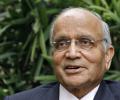
Maruti Suzuki chairman RC Bhargava has said that reducing carbon emissions does not require making a choice between hybrid and electric cars, and that both can play key and complementary roles if the government wants to achieve its aggressive emissions target. Responding to the fact that the sales numbers of hybrid cars have been higher than electric cars in the last quarter of 2024, Bhargava pointed out: "It has never been about electric versus hybrid. "Both have a clear role to play. By 2030 we expect electric car penetration to be around 20 per cent.

Air quality index (AQI) soared past 350 level in parts of Delhi on Thursday and experts cautioned that as weather turns colder it may breach the 400-mark ceiling and enter the 'severe' zone soon, notwithstanding the incidents of stubble burnings which have nosedived from 17,529 in 2020 to 4,262 this year.

Tata Motors on Friday reported a 62.2 per cent decline in consolidated net profit to Rs 4,003 crore in the June quarter, impacted by volume decline across segments, drop in JLR profits due to US tariffs and high base effect due to gain from sale of discontinued operations. The auto major had posted a consolidated net profit of Rs 10,587 crore in the April-June quarter of the previous fiscal, Tata Motors Ltd (TML) said in a regulatory filing.

According to the report by Swiss firm IQAir released on Tuesday, India's annual average PM2.5 level in 2022 was 53.3 g/m3, slightly lower than the 2021 average of 58.1.

iPhone maker Apple has met its replenishment target for freshwater withdrawals for corporate operations in India in 2023, the company said in its environmental progress report released on Wednesday. Globally, Apple has set a goal to replenish 100 per cent of corporate freshwater withdrawals in high-stress locations by 2030.

If I were to explain stealth to a layperson, I'd ask them to think of the game chupan-chupai (hide and seek) we played as children, explains Air Commodore Nitin Sathe (retd).

The Delhi government has announced that vehicles older than 15 years will be denied fuel at petrol pumps starting April 1.

'Battery electric, hydrogen fuel cell and hydrogen ICE, could be the three technologies which have the potential of being zero emission and that are what we will have to work on,'

Asserting that it has been a strong champion of equity, India on Thursday said developed countries should compensate developing nations for the effects their greenhouse gas emissions have had on climate.
Passenger and commercial vehicle prices are expected to rise as automobile companies invest in upgrading vehicles to meet stricter emission norms that kick in from April next year. The Indian automobile industry is currently working to make their products meet the second phase of Bharat Stage VI, equivalent to Euro-VI emission norms, in real time driving conditions. Four-wheeler passenger and commercial vehicles will need more sophisticated equipment to be added to meet the next level of emission standards.

'There is no linkage as far as the Indian power-generating business is concerned.'

The country's biggest carmaker, Maruti Suzuki India, has raised concerns about the continuing slide in small car sales.

'Two would be premium products and three would be mainstream products.'

India decided to cut down its carbon emission intensity by 20-25 per cent by 2020 in the run up to the Copenhagen summit, shortly after a similar declaration by China.

Ramesh expressed deep concern about the US offer to reduce carbon emissions by 17 per cent from 2005 levels.
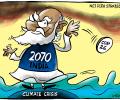
Three years after India declared its goal to become a net-zero economy by 2070, the policy design for achieving the target has begun, with the NITI Aayog forming dedicated multi-sectoral committees to prepare a transition plan. In 2021, India joined a select group of nations that set a target year for becoming net-zero carbon economy. At COP26 in Glasgow, Prime Minister Narendra Modi outlined a five-pronged 'Panchamitra' climate action target for India and committed to a net-zero target by 2070, joining nations like the US, the UK, and China.

'The intensity and frequency of heatwaves will be much higher than in previous years over Punjab, Haryana, Rajasthan, Gujarat, Madhya Pradesh and Odisha.'

EU operates as one block at the climate change negotiations and takes a single greenhouse gas emission reduction target under the Paris Agreement
India's JSW Steel has been awarded more than 5.4 million carbon credits, including four million carbon credits in the single largest issuance of emissions permits to a Kyoto Protocol project, by the United Nations.

In mid-May, the European Commission released 2009 data showing carbon emission in the region had fallen 11 per cent over last year, to 1.873 billion tonnes.

'At present, hybrids emit lesser carbon despite using fuel than pure play electric cars.' 'That is because EVs have to be charged and 76 per cent of the country's electricity is still coal-based and not renewables.'

Amidst growing concern that India and the United States are on a collision course over reduction of carbon emissions in the run-up to the climate change conference in Copenhagen later this year, India's Ambassador to the US, Meera Shankar said that for a country like India with a severe energy shortage, absolute reductions of emissions is extremely challenging and well nigh impossible.
In a significant development, India's National Commodity & Derivatives Exchange Limited on Thursday launched its futures contract for Certified Emission Reduction. Forward Markets Commission, chairman, B. C. Khatua inaugurated the launch at NCDEX Exchange Platform. The CER contract of NCDEX will be traded in multiples of one lot of 500 CERs each.
The Maryland House of Delegates has passed major legislation authored by Majority Leader Kumar Barve--the longest-serving Indian American legislator--to dramatically reduce greenhouse gas emissions in the state.

At the grand global policy-making level, the Indian government is heatedly arguing with the developed world over its share of stringent new carbon emission reductions.

Oil and Natural Gas Corporation (ONGC) on Monday said it has received 10,722 emission reduction certificates from the United Nations for a waste heat recovery project at its Mumbai High fields.
The United States, India and China are not in favor of accepting a legally binding agreement.
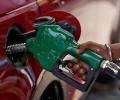
Petrol doped with 20 per cent ethanol was rolled out on Monday at select petrol pumps in 11 states and union territories as part of a programme to increase use of biofuels to cut emissions as well as dependence on foreign exchange-draining imports. At present, 10 per cent ethanol is blended in petrol (10 per cent ethanol, 90 per cent petrol) and the government is looking to double this quantity by 2025. Prime Minister Narendra Modi launched the higher 20 per cent ethanol blended petrol two months ahead of the planned rollout in April, at the India Energy Week (IEW) 2023 in Bengaluru.

'We are not asking for incentives, but at least taxation can be aligned such that the rupee tax on consumers remains the same.'

Global demand for carbon credits, especially in Europe for economic reasons, has been declining since 2010

'It will take some more time because the affordability of these cars have changed drastically.'

MCX launched contracts in gold, heating oil, gasoline, natural gas, sliver HNI and aviation turbine fuel (ATF). The futures contracts will expire between February and May and the trading specifications will remain unchanged, the exchanges said.

India on Thursday made it clear that it would not accept any internationally binding agreement and that its climate change targets were not up for review.
